From JAMstack to CAMstack: Bridging the Content Gap
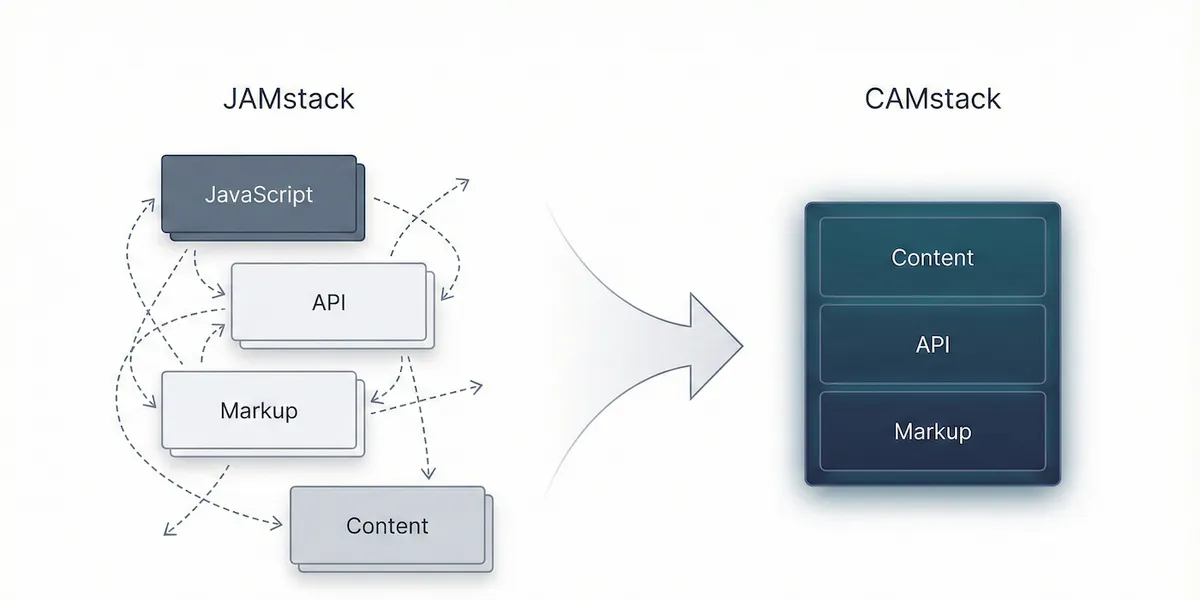
The JAMstack changed how developers think about building websites. By decoupling the frontend from the backend and pre-rendering everything at build time, it delivered blazing-fast sites that were easy to deploy and cheap to operate. But as JAMstack adoption matured, a gap emerged — one that no amount of clever tooling could fully paper over.
Content management was bolted on, not built in.
SleekCMS is CAMstack — the first platform built around the principle that Content, API, and Markup belong together as a single, unified system. Not three tools stitched together. One platform, designed from the ground up so that structured content drives everything: the editing experience, the delivery API, and the cloud build pipeline that generates your site.
What JAMstack Got Right
The original JAMstack formula — JavaScript, APIs, Markup — was a genuine breakthrough. Serving pre-generated HTML from a CDN eliminated the per-request overhead of traditional server-rendered stacks. Sites got faster. Infrastructure got simpler. Developers got to work with the frontend tools they already loved.
The API pillar was particularly forward-thinking. Decoupling data from presentation meant you could swap out your backend without rebuilding your frontend, and vice versa. This was the philosophical foundation for the headless CMS category — a database for content that delivers through APIs rather than HTML.
What JAMstack got right was the delivery architecture. What it left underspecified was the content architecture.
The JAMstack Content Problem
In practice, "content" in a JAMstack site often meant one of two things: markdown files in a Git repository, or entries in a third-party headless CMS that felt grafted onto the stack. Both approaches work. Neither is ideal.
Markdown files in Git are beloved by developers and bewildering to everyone else. Asking a marketing manager to open a pull request to update a homepage hero is not a content workflow — it's a hazing ritual. The moment a non-developer needs to touch the site, the whole model breaks down.
Third-party headless CMSs solved the editing problem but created new ones. You had a CMS over here and a site builder over there, a content model in one system and a component library in another, and a build pipeline threading them together with baling wire. Every content change triggered a rebuild. Every rebuild meant waiting. Every deploy was a coordinated handoff between systems that didn't know about each other.
The content layer was always the awkward middle child of the JAMstack family.
Enter CAMstack: Content, API, Markup
CAMstack starts with a simple observation: content, API delivery, and static markup generation are not three separate concerns stitched together — they are one system, and they should be designed as one system.
Content is structured. Real content isn't a blob of markdown. It's a title (text), a hero_image (image object with dimensions and alt text), a published_date (date), and a sections field (an ordered array of typed content blocks). When you model content this way, you can validate it, query it, transform it, and render it consistently across every surface where it appears — your website, your mobile app, your RSS feed.
API is the universal delivery contract. Structured content flows through a typed API that any consumer can read. Your static site builder uses it at build time. A React app uses it at runtime. A third-party integration uses it asynchronously. The API is the single source of truth, and everything downstream is a consumer.
Markup is the output, not the source of truth. Static HTML is generated from structured content and templates. It's fast, portable, and cacheable — the same reasons JAMstack loved it. But in the CAMstack model, the markup layer knows about the content layer. It doesn't have to reverse-engineer structure from flat files or stitch together API calls during a build. The content is already structured, already typed, already ready to render.
The shift is subtle but profound. JAMstack treated static site generation as a build tool problem. CAMstack treats it as a content delivery problem.
How SleekCMS Implements CAMstack
The insight at the heart of SleekCMS is deceptively simple: by combining a headless CMS with an integrated static site builder, you can collapse the complexity that JAMstack toolchains never fully resolved. Content modeled in the CMS maps directly to the pages that get built. There is no translation layer, no custom integration, no glue code — the structured content is the site, and the site is a direct rendering of the structured content.
Routing Is Content
In most JAMstack setups, routing is a frontend concern. You configure paths in your framework, point them at data fetching logic, and hope the content structure matches what your templates expect. When it doesn't, you write adapters.
SleekCMS turns this inside out. Routing is defined in the content model. A page model with a path of /blog and a slug field automatically produces one URL per content record — /blog/hello-world, /blog/getting-started, /blog/my-latest-post — with no framework configuration required. Add a new blog post and a new route exists. The content and the URL structure are the same declaration, not two systems that have to be kept in sync.
This is what it means to treat static site generation as a content delivery problem rather than a build tool problem. The content model is the routing table. The content records are the pages.
Consuming Content Becomes Trivial
The payoff of this unification is how dramatically it simplifies content consumption in templates. Because the content is already structured, already resolved, and already mapped to a page, a template doesn't need to fetch, join, or transform anything. It just renders.
<!-- blog post template: item is the current page record, fully resolved -->
<article>
  <h1><%= item.title %></h1>
  <time><%= item.published_date %></time>

  <!-- References resolve inline — no API calls, no joins -->
  <div class="author">
    <%- picture(item.author.headshot, '80x80') %>
    <span><%= item.author.name %></span>
  </div>

  <!-- Render composable block sections in editor order -->
  <%- render(item.sections) %>
</article>
There are no secondary API calls. No waterfall fetches. No schema mismatches between what the CMS stores and what the template expects. The content arrives structured, typed, and complete — because the model that defined it and the pipeline that delivers it are the same system.
The Cloud Build Pipeline: The Piece That Makes CAMstack Possible
The final piece is the one that most directly addresses the JAMstack's content-delivery tension — and the one that required the hardest architectural decisions to get right.
To make CAMstack real, SleekCMS moved the entire build pipeline to the cloud. This wasn't an incremental improvement. It was a fundamental rethinking of where site generation lives and who it belongs to.
In a traditional JAMstack setup, building the site is a developer concern. You configure a build tool, write scripts, connect a CI/CD pipeline, and trigger rebuilds when content changes. Content editors work around this infrastructure. They update a CMS, wait for a webhook, hope the build succeeds, and check back later to see their changes live.
SleekCMS eliminated all of that. When a content editor publishes a change or when you trigger a build, SleekCMS runs the entire static site generation in the cloud — compiling your view templates against your structured content, resolving all references and block compositions, bundling assets, and producing a complete, deployment-ready static site. No local build tools. No CI/CD configuration. No npm scripts.
There is no Git repository. There is no pipeline to maintain. There is no waiting room between "I published this content" and "I can see this content."
This is what makes CAMstack more than a philosophical reframing. Moving the build to the cloud is what allows content, API, and markup generation to be genuinely unified. The cloud builder has full access to the same structured content that powers the API. It uses the same model definitions that drive the editor. The output is a direct rendering of the content architecture — not a downstream artifact of a separate system that happens to consume an API.
You bind view templates to your models, compose pages using blocks, and the cloud builder handles the rest. A full site build is one click. Deployment to Netlify, Vercel, or any static host follows immediately after.
This is what "C" in CAMstack means in practice. Content isn't just stored here and delivered over there. It is the foundation of the entire system — from the model definition, to the editor experience, to the cloud build, to the API response shape. Every layer is designed around the structure of the content. That is only possible when all the layers live in the same place.
CAMstack for Developers and Content Teams
One of JAMstack's unresolved tensions was the gap between developer ergonomics and editor experience. Developers loved the Git-based workflow. Content teams were often excluded from it entirely, relegated to a separate CMS that felt disconnected from the actual site.
CAMstack, and SleekCMS specifically, is designed to work for both groups without compromising either.
Developers get a clean content API, a typed JavaScript client, full TypeScript support, and complete control over how content renders through view templates. The structured content model means every API response is predictable. No more undefined is not an object because an author forgot to fill in a field. No more layout-breaking content because an editor used the wrong image dimensions.
<!-- layout.ejs: the shared HTML shell every page uses -->
<!DOCTYPE html>
<html lang="en">
<head>
</head>
<body>
  <nav>
    <% getEntry('nav').links.forEach(link => { %>
      <a href="<%= link.url %>"><%= link.label %></a>
    <% }) %>
  </nav>

  <%- main %>

  <footer><%- getEntry('footer').copyright_text %></footer>
</body>
</html>
Content teams get a visual editing experience where they compose pages from a library of pre-built, properly structured block types, with a live preview that shows exactly how the page will render. No Git. No pull requests. No waiting for a developer to add a new field to a markdown schema.
The Content API as First-Class Infrastructure
In the CAMstack model, the content API is infrastructure, not an integration. This is a meaningful distinction.
SleekCMS delivers content through a CDN-cached API endpoint that any consumer can use. The static site builder consumes it at build time to generate HTML. A React application can consume it at runtime to power an SPA. A mobile app can consume it for push notification copy. An RSS feed can consume it for syndication.
<!-- hero block template: item is this block's fields -->
<section class="hero" style="background-image: url('<%- src(item.image, '1600x900') %>')">
  <h1><%= item.heading %></h1>
  <p><%= item.subheading %></p>
  <a href="<%= item.cta_url %>" class="btn"><%= item.cta_label %></a>
</section>

<!-- blog index template: find all posts across the site -->
<% getPages('/blog/').forEach(post => { %>
  <article>
    <%- img(post.image, '600x400') %>
    <h2><a href="<%- path(post) %>"><%= post.title %></a></h2>
    <span><%= post.author.name %></span>
  </article>
<% }) %>
Every reference resolves inline. There are no secondary API calls to fetch related data. The content is fully structured and fully resolved at the API layer, which means every consumer gets exactly what it needs in a single request.
From Stack to System
The JAMstack was never just a technical architecture — it was a set of values. Pre-generate what you can. Separate concerns cleanly. Serve from the edge. Trust the web platform. Those values are still right.
CAMstack extends them to the content layer, the piece JAMstack left underspecified. Content should be structured, not flat. It should be owned by the content team, not hidden in code. The build should live in the cloud, not on a developer's laptop or in a CI pipeline someone has to maintain. Content should be the foundation of the delivery architecture, not the last thing you bolt on.
SleekCMS didn't adapt to these principles — it was built to define them. The content model, the cloud build pipeline, the structured API, the block-based editing experience: none of these are features added to an existing CMS. They are the system. Each layer was designed with the others in mind, which is why they work together in a way that assembled JAMstack toolchains never quite managed.
If you've felt the friction of the JAMstack content gap — the Git-for-content awkwardness, the webhook rebuild loop, the CMS that doesn't know about your components — you've felt the problem CAMstack solves. CAMstack is the name for what SleekCMS is.